
AI API & Developer Tools
Mistral Large 4: What It Is, What It Can Do, and How to Evaluate It
A source-checked guide to Mistral Large 4: its open-weight MoE architecture, multimodal capabilities, 1M context window, API pricing, agentic coding strengths, and deployment trade-offs.

Mistral Large 4: What It Is, What It Can Do, and How to Evaluate It
Mistral Large 4 is Mistral AI’s open-weight, general-purpose multimodal model, combining text and image understanding with reasoning, coding, tool use, and agentic workflows. The model is notable less because “one trillion parameters” is a large headline and more because it combines a granular Mixture-of-Experts design, a 1M-token context window, a 1.6B-parameter vision encoder, and a deployment story that includes Mistral’s API, regional inference, private cloud, and on-premises use.
The practical conclusion is straightforward: Mistral Large 4 is worth testing for long-context document work, visual grounding, software engineering agents, and organizations that value open weights or European control. It is not automatically the best model for every prompt, and its published benchmark claims should be treated as a starting point for task-specific evaluation. If you are comparing providers or building a multi-model product, you can also use the 01Router AI gateway to keep model selection and application integration separate.
This guide reviews the model as of October 30, 2026. The release is moving quickly: model weights, prices, regional availability, safety behavior, and provider limits can change. The official announcement describes a public preview launched on October 6, 2026, while the model page identifies Mistral Large 4 as public preview and open-weight under the Mistral Ecosystem Open Weight License v26.10.
Editorial note: the illustrations are conceptual information-technology sketches. They are not diagrams of Mistral’s private infrastructure or a literal rendering of the model graph.
Table of contents
- Mistral Large 4 in one minute
- What the architecture means
- Multimodal understanding and the 1M context window
- Coding, agents, and reasoning
- Open weights and deployment choices
- Pricing and API economics
- How to evaluate it without being misled by benchmarks
- Who should use Mistral Large 4?
- Common questions
- Sources and verification notes
Mistral Large 4 in one minute
| Question | Evidence-led answer |
|---|---|
| What is it? | An open-weight, general-purpose multimodal model from Mistral AI. |
| What does multimodal mean here? | The model accepts text and images, including documents, charts, diagrams, screenshots, and natural images. |
| What architecture does it use? | A granular Mixture-of-Experts architecture with 1.05T total parameters and 52B active parameters, according to the official model page. |
| How much context does it support? | The official model page lists a 1M-token context window. Service-specific limits can be smaller. |
| What is distinctive? | It brings instruction following, reasoning, coding, visual understanding, and agentic use into one general-purpose model. |
| Is it open source? | Mistral calls it open-weight. That is more precise than promising that every training artifact, dataset, or service component is open source. |
| What does API usage cost? | Mistral’s current pricing page lists $0.70 per million input tokens, $0.07 per million cached input tokens, and $2.10 per million output tokens for the standard API listing. Verify the live price before budgeting. |
| Should you deploy it yourself? | Only if the model’s quality, hardware requirements, license, privacy needs, and operational budget fit your workload. |
What the architecture means
Mistral Large 4 uses a granular Mixture-of-Experts, or MoE, architecture. In a dense model, every input token passes through the same full set of model parameters. In an MoE model, a router selects a small group of specialized expert components for each token. The model can therefore have a very large total capacity without activating every parameter for every token.
The official model page lists 1.05 trillion total parameters and 52 billion active parameters. “Active” does not mean that the remaining parameters are irrelevant; it means that the inference path uses a selected subset for a given token. The distinction affects throughput, memory planning, routing behavior, and the type of hardware required. It does not by itself prove that the model is cheaper, faster, or more accurate than a smaller dense model.
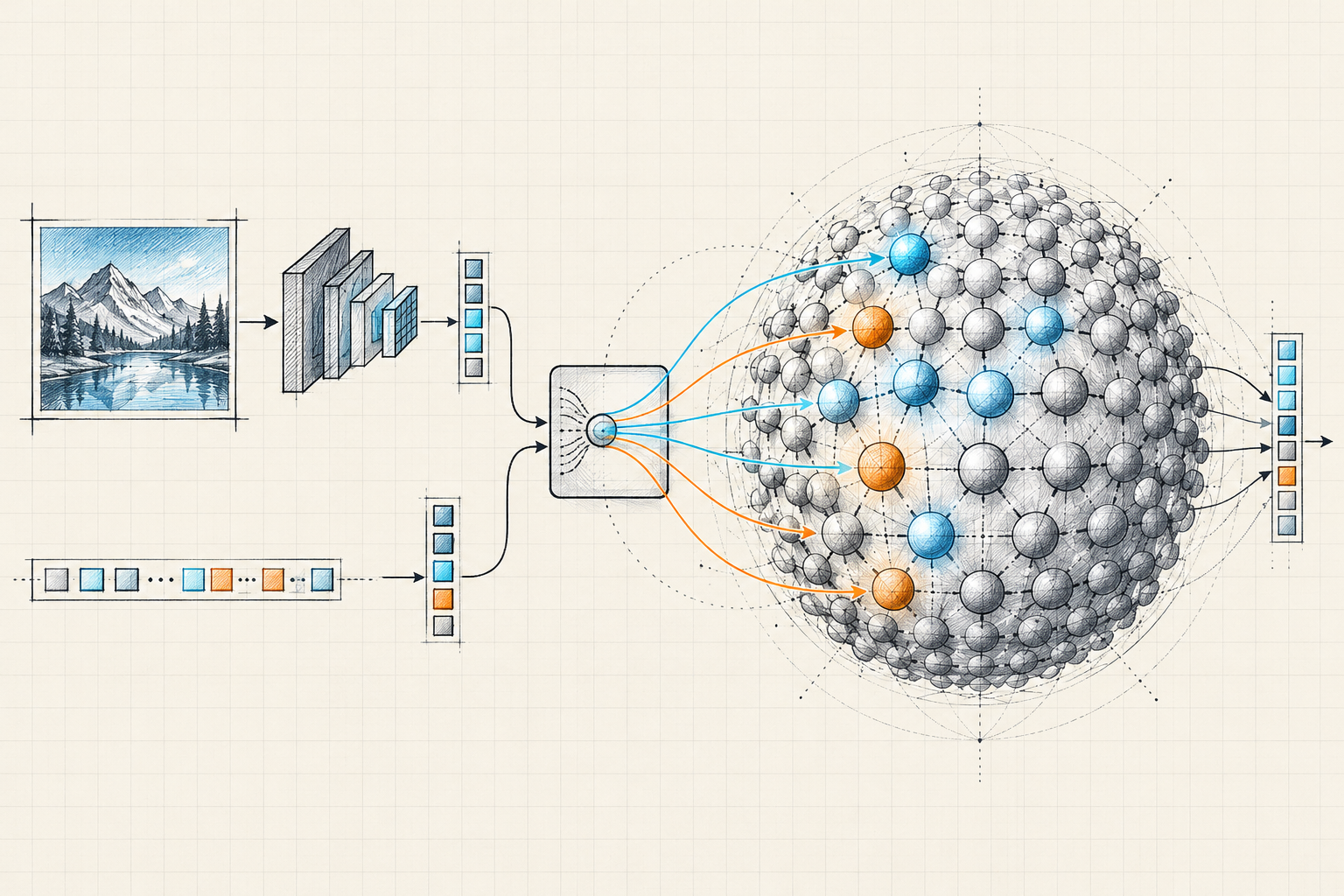
The same model page lists a 1.6B vision encoder. This is important for developers: image understanding is not just a text model with a captioning helper bolted on. The model’s visual input path is part of the published model specification. It still does not mean that every visual task is solved equally well. Small text, rotated tables, low-resolution screenshots, dense technical drawings, and images with missing context should be tested directly.
The architectural headline is most useful when translated into an engineering question: can the model give your application enough capability per unit of latency and cost? For an interactive chatbot, a smaller model may feel better. For a repository-level coding agent or a long technical dossier, the extra capacity and context may be more valuable. Benchmark charts cannot answer that trade-off for you.
Multimodal understanding and the 1M context window
Mistral Large 4 is positioned as a multimodal model for text and images. Useful applications include:
- asking questions about a set of diagrams, screenshots, or scanned pages;
- extracting evidence from a contract or technical report;
- inspecting engineering drawings and identifying a region that needs attention;
- comparing a chart with an accompanying narrative;
- combining a visual input with a code or tool-use task.

The official page lists a 1M-token context window, but context capacity is not the same as guaranteed attention quality. A model can accept a large input and still miss a crucial detail buried in the middle. Your evaluation should vary document length, repeated terminology, table density, image resolution, and the location of the answer. Measure both answer accuracy and the amount of context you must provide before the model becomes reliable.

The reference guide at mistrallarge4.com makes a useful product distinction: the 1M-token model context is not the same as the shorter limits of its public playground. The same distinction applies to every hosted service. An API provider may enforce request-body, file-size, output-token, rate, or conversation limits below the model’s theoretical maximum.
For production, use the long context strategically rather than dumping every available file into every request. Start with retrieval, document segmentation, page or section references, and a request for quoted evidence. Then test whether a larger context reduces retrieval mistakes enough to justify its token cost and latency. Long context is a capability; it is not a substitute for information architecture.
Coding, agents, and reasoning
Mistral presents Large 4 as a model for coding, agentic workflows, and complex professional tasks. The announcement reports results on coding and agent evaluations including DeepSWE, SWE-Atlas-QnA, Terminal-Bench 4, AutomationBench, and AA-Briefcase. It also describes internal or partner evaluations across finance, law, engineering, manufacturing, and cybersecurity.
Those results are relevant but should be read as Mistral’s reported evaluation, not as a universal ranking. Scores depend on prompt scaffolding, tool access, model version, grading procedure, and whether the comparison uses the same budget and timeout. The announcement itself says that additional benchmarks and post-training details would follow as the release matured.
For coding agents, the model’s likely value is the combination of repository understanding, long context, tool calling, and sustained multi-step work. A useful agent loop is:
- Inspect the task and repository constraints.
- Form a plan with explicit assumptions.
- Read only the files needed for the next step.
- Make a small change.
- Run tests, linters, or a type checker.
- Review the diff and ask for human approval before risky actions.
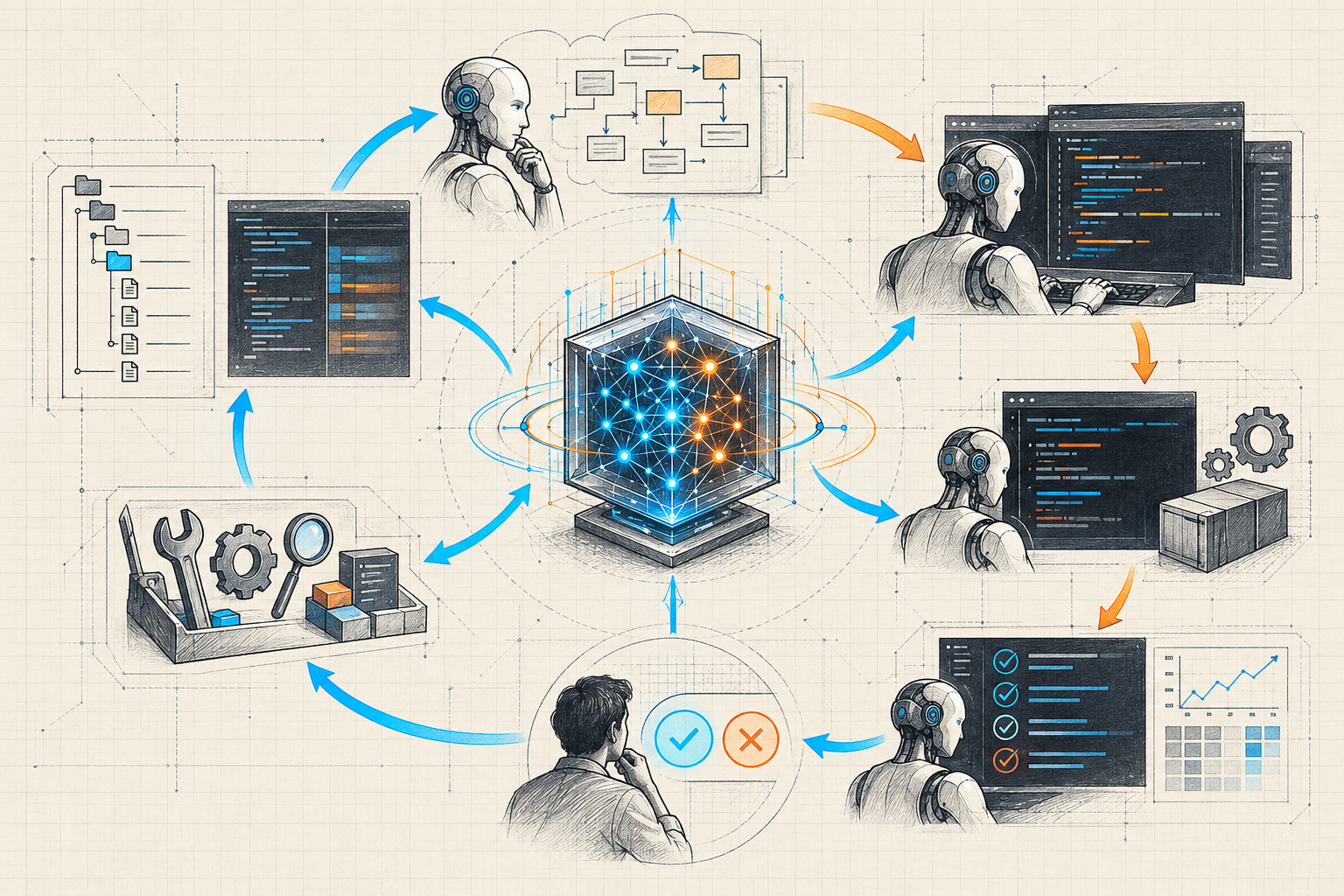
This workflow matters more than a single “writes code” score. A model can produce impressive snippets and still lose time through unnecessary edits, fail to respect a local convention, or report a passing result without running the right test. Evaluate complete task trajectories: time to a correct patch, number of tool calls, revert rate, test pass rate, and the quality of the final explanation.
Reasoning settings also need a budget. If a product exposes adjustable reasoning effort, compare direct answers with deeper reasoning on the same task. Record latency and output tokens, not just whether the final answer is correct. For simple classification or extraction, additional reasoning may increase cost without improving the outcome.
Open weights and deployment choices
Mistral calls Large 4 an open-weight model. Open weights can give an organization more control over where inference runs, how a model is audited, and what happens if a hosted provider changes its policies or availability. They do not remove the need to read the license, secure the serving stack, manage GPU capacity, patch dependencies, and build safety controls.
The official launch material frames Mistral Large 4 as part of a European infrastructure and AI-sovereignty strategy. It says the model was trained on Mistral’s European infrastructure and describes availability across multiple regions, including a European deployment operated under European law. These are meaningful options for organizations with data-residency or continuity requirements, but “European” is not a complete security assessment. Ask where logs, support data, backups, telemetry, and subprocessors are located.
There are four practical deployment paths:
| Path | Best when | Main risk |
|---|---|---|
| Managed Mistral API | You need fast integration and elastic capacity. | Provider limits, changing prices, and data-governance review. |
| Regional or priority hosted inference | You need regional control or more predictable service behavior. | Higher price or limited model/region availability. |
| Private cloud | You need network and access-control boundaries but can operate GPU infrastructure. | Capacity planning and operational overhead. |
| On-premises | Data cannot leave your controlled environment and you have the required hardware team. | Capital cost, serving complexity, upgrades, and utilization. |

Choose the path after measuring the workload, not before. An open-weight model can be the right strategic asset while a managed API remains the right first deployment. A hybrid design can keep sensitive workloads private and route lower-risk workloads to a hosted endpoint.
Pricing and API economics
At the time of review, Mistral’s official API pricing page lists Large 4 at $0.70 per million input tokens, $0.07 per million cached input tokens, and $2.10 per million output tokens for the standard price table. The model page also shows a 1M context window and features such as structured outputs, function calling, document Q&A, batching, agents, and built-in tools. Pricing and feature availability are service-specific; check the live page before publishing a quote or setting a customer price.
An approximate text-only request cost is:
cost = (input_tokens × 0.70 / 1,000,000)
     + (cached_input_tokens × 0.07 / 1,000,000)
     + (output_tokens × 2.10 / 1,000,000)
The formula is useful for a first estimate, but it is not a unit-economics model. Add image processing, tool calls, retries, moderation, storage, vector retrieval, observability, and human review. For a long-context application, calculate cost per accepted result rather than cost per request. If a workflow makes three attempts before a reviewer accepts one answer, the first two attempts belong in the accepted-result cost.
Caching deserves its own measurement. A stable system prompt, repeated policy text, or shared repository prefix may be cacheable, but only if the provider’s caching semantics and cache key match your request pattern. Record cache hits, input tokens, output tokens, and latency so that you can see whether a large context is really reusable.
If price predictability matters, put a preflight estimate and a hard budget around every agent run. Do not let a model choose arbitrary tools, files, or recursive sub-agents without a server-side limit. 01Router pricing is a useful internal reference point when comparing the cost of a single-model integration with a gateway that can route different tasks to different models.
How to evaluate it without being misled by benchmarks
Run a small, representative evaluation before deciding. A seven-day test can be enough to answer the first deployment question if the dataset is chosen well.
1. Build a task matrix
Use real or carefully anonymized examples from five groups: ordinary chat, long documents, visual questions, coding tasks, and tool-using workflows. Include easy, typical, and failure-prone cases. Keep a frozen test set so that prompt changes do not hide regressions.
2. Define correctness before calling the model
For extraction, define a schema and validate it. For coding, run tests and inspect the diff. For document Q&A, require evidence locations. For image understanding, mark the exact regions or values that matter. Human preference alone is too noisy for a production decision.
3. Measure the whole path
Track time to first token, time to final answer, input and output tokens, cache hits, tool calls, retries, errors, refusal behavior, and cost. Test cold and warm conditions. A model that wins quality but doubles latency may still be right for asynchronous back-office work and wrong for a live assistant.
4. Test the safety boundary
Include prompt injection in documents, malicious tool arguments, sensitive data, unsafe code, ambiguous authority, and requests that should be refused. Open weights provide control, but they also transfer more responsibility to the deployer. Keep tools behind validation and least-privilege credentials.
5. Compare against a baseline
The baseline can be your current model, a smaller Mistral model, or a direct deterministic system. The question is not whether Large 4 looks impressive in isolation. The question is whether it improves the outcome enough to justify the extra cost, hardware, latency, or operational risk.
Who should use Mistral Large 4?
Mistral Large 4 is a strong candidate when you need several of these properties at once:
- multimodal input for documents, diagrams, screenshots, or charts;
- a very large context window for repository or dossier-level work;
- coding and tool use in the same general-purpose model;
- open-weight or self-deployment options;
- regional, private, or sovereign inference requirements;
- a model that can be evaluated across both ordinary answers and long-horizon agents.
It is a less obvious first choice when your application needs extremely low latency, a tiny deployment footprint, simple classification, or a mature narrow-domain model whose behavior is already well understood. The best architecture may pair Large 4 with smaller models: use the larger model for difficult cases, visual grounding, or planning, and route routine transformations to cheaper specialists.
Common questions
Is Mistral Large 4 open source?
Mistral describes it as open-weight and the model page lists the Mistral Ecosystem Open Weight License v26.10. “Open-weight” is the safest description. Read the license and deployment terms before assuming that all training data, tooling, or commercial uses have the same freedoms as the weights.
Is Mistral Large 4 multimodal?
Yes. The official model page describes it as a general-purpose multimodal model and lists a 1.6B vision encoder. In practice, test the exact image and document formats your product will receive.
Does it really support a 1M context window?
The official model page lists 1M tokens. A hosted playground, API gateway, SDK, or account may enforce lower request or output limits. Confirm the service-specific limit and test long-context recall rather than relying on the number alone.
What is the current Mistral Large 4 API price?
At this review date, Mistral’s API pricing page lists $0.70 per million input tokens, $0.07 per million cached input tokens, and $2.10 per million output tokens. Prices may vary by tier, region, batch mode, or provider, so verify the live pricing page before committing to a budget.
Is it good for coding agents?
It is designed and evaluated for coding and agentic workflows, and Mistral reports strong results on several coding and automation evaluations. Your own agent loop, tools, repository size, tests, and approval policy will determine the production result.
Should I self-host it?
Self-hosting can make sense for privacy, continuity, or control, but the total cost includes GPUs, serving software, monitoring, upgrades, security, and capacity. Start with a measured managed deployment unless your requirements already justify private infrastructure.
Can it replace every other model?
No. A general-purpose flagship can cover many tasks, but specialized models may be cheaper, faster, or more reliable for OCR, embeddings, speech, moderation, or small structured transformations. Use routing and evaluation rather than a one-model ideology.
What is the best way to try it?
Start with a small test set of real tasks, ask for evidence, inspect tool calls, and compare quality, latency, and cost against a baseline. The 01Router journal can provide a broader context for evaluating new AI models and APIs as the ecosystem changes.
Sources and verification notes
- Mistral AI: Introducing Mistral Large 4 — launch date, public-preview status, architecture headline, capabilities, reported evaluations, infrastructure, and roadmap.
- Mistral Docs: Mistral Large 4 model page — 1.05T total parameters, 52B active parameters, 1.6B vision encoder, 1M context, features, license, and model-page pricing.
- Mistral Docs: API pricing — current generalist-model token prices used in this article.
- Mistral API reference — chat-completion request fields, streaming, tools, JSON output, and SDK examples.
- Mistral Large 4 reference guide — playground limits, practical usage framing, and a non-official product-oriented overview. Claims about the model itself were checked against Mistral’s official sources.
The figures and feature descriptions above were reviewed on October 30, 2026. Mistral Large 4 remains a moving target; re-check model availability, license, price, safety behavior, and service limits before using this article as an implementation specification.